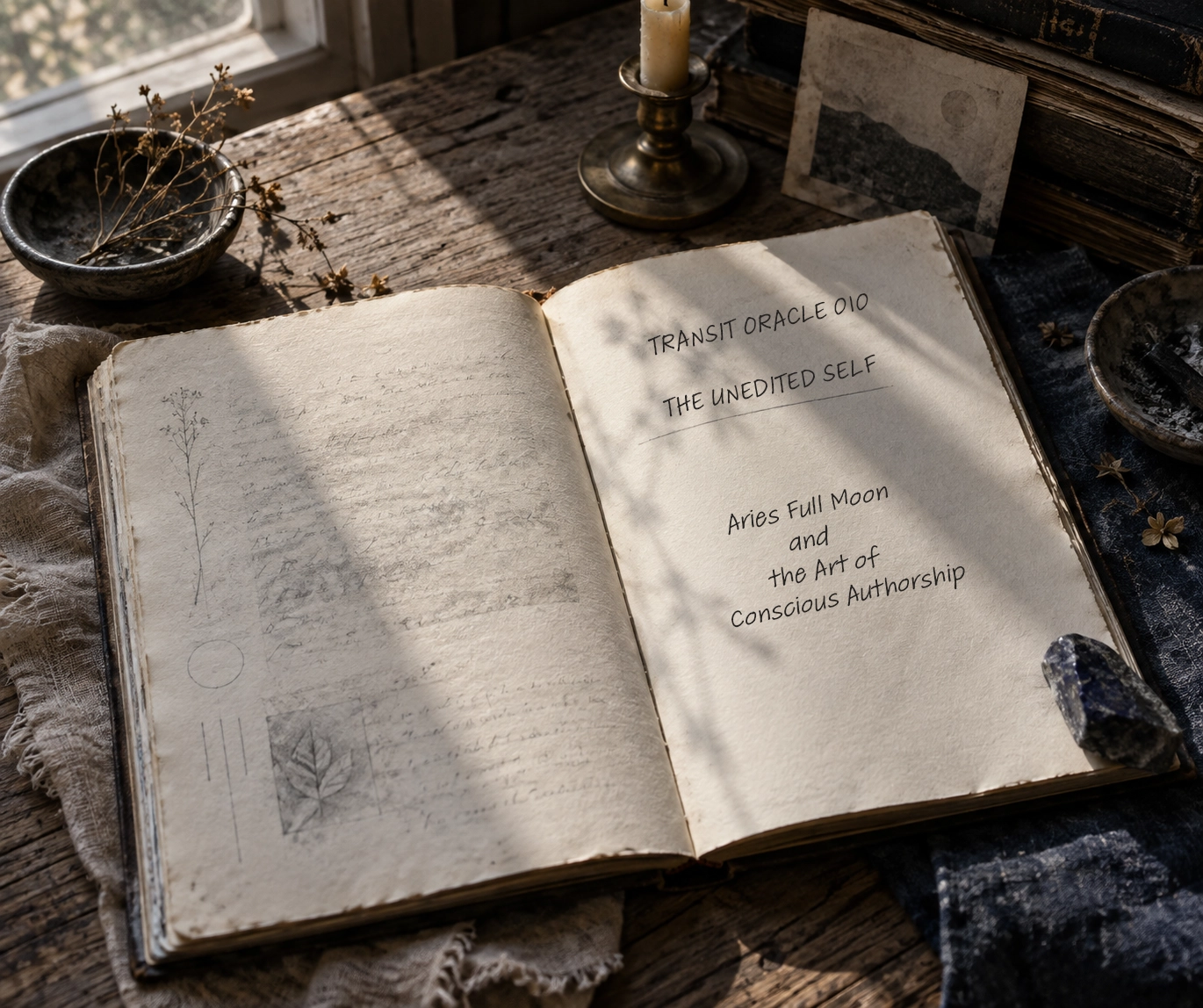
The Unedited Self: Aries Full Moon and the Art of Conscious Authorship
What happens when we stop asking how to become acceptable and begin asking who is actually holding the pen?
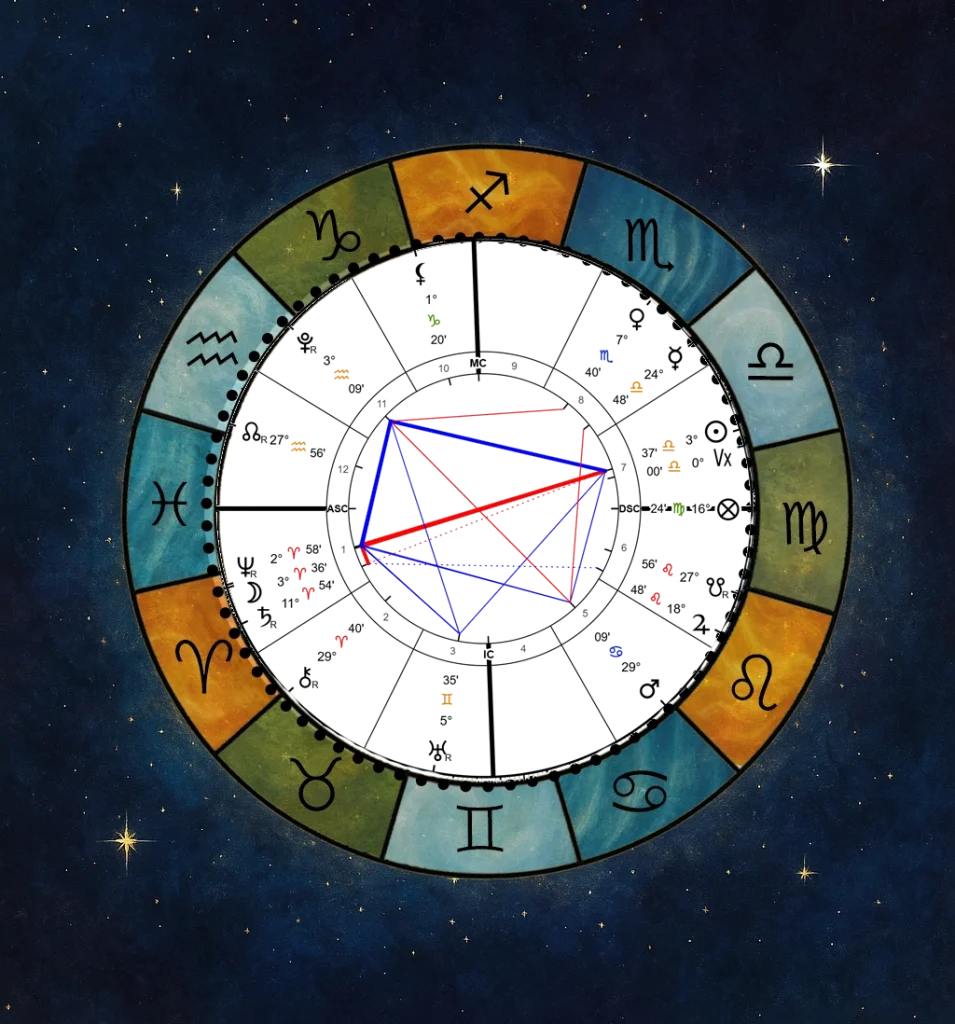
Exact Lunation
☽ Aries Full Moon — September 26, 2026 • 12:48 PM EDT • 3°36′ Aries
September 26 • 4:48 PM UTC
Core Aspects
♆ Moon conjunct Neptune in Aries — orb ~0°37′
♇ Moon sextile Pluto in Aquarius — orb ~0°27′
♅ Moon sextile Uranus in Gemini — orb ~1°59′
⚸ Mean Lilith in Capricorn square the Full Moon axis — orb ~2°16′
Background Sky
☉ Sun entering Libra on the Equinox
⚷ Chiron retrograde newly returned to Aries
♂ Mars at 29° Cancer, preparing to enter Leo the following evening
♅ ♇ Libra Sun forming a Grand Air Trine with Uranus in Gemini and Pluto in Aquarius, creating a kite-like configuration through the Aries Full Moon
Oracle Window
Preparation + Recognition: September 22–25
Full Moon Threshold: September 26
Authorship + Activation: September 27–30
Lunation Arc: September 26–October 10
Some aspects of our identity are crafted with intention, while others are quietly revised through subtle, almost imperceptible compromises.
A softened opinion here. A swallowed no there. The instinct we learned to second-guess because it complicated the room. The desire we translated into something more reasonable. The anger we made productive. The ambition we made respectable. The tenderness we learned to ration. The truth we rehearsed until it could be spoken without making anyone uncomfortable.
Eventually, the edits become seamless.
We call them maturity. Professionalism. Partnership. Responsibility. Being easy to love. Being good at what we do.
And sometimes they are.
But under this Aries Full Moon, the sky seems interested in a more uncomfortable question:
What if some of the person you have worked so hard to become was built around what you learned you could not safely be?
On September 26, the Full Moon illuminates the Aries–Libra axis: the ancient conversation between self and other, autonomy and relationship, instinct and consideration, the truth that rises from within us and the agreements we make once another person enters the room.
It would be easy to make Aries the hero of this story.
Choose yourself.
Stop compromising.
Say what you want.
Burn the bridge.
Begin again.
But the sky is not speaking in separate sentences. These movements are responding to one another.
The Aries Moon is entangled with Neptune, and Neptune changes the texture of certainty. The boundary between what is mine and what I have absorbed becomes more permeable. Desire can arrive braided with longing. Intuition can mingle with projection. An old wound can sound remarkably like an inner knowing when it has been speaking in our voice for long enough.
So perhaps this Full Moon is not asking us to act on every feeling that rises.
Perhaps it is asking us to become intimate enough with ourselves to recognize who is speaking when it does.
I’ve been noticing how much of becoming ourselves is actually an exercise in discernment.
Not simply, What do I feel?
But: Where did I learn to feel responsible for this?
Not simply, What do I want?
But: Would I still want it if no one were watching?
Not simply, What is my intuition telling me?
But: Is this intuition—or is this an old adaptation that became so familiar I started calling it wisdom?
That distinction matters now.
Because above the deeply personal Aries–Libra conversation, the air in this chart is moving.
The Libra Sun participates in an airy geometry with Uranus and Pluto, linking the immediate question of relationship to something larger: changing language, changing ideas, changing social agreements, changing understandings of what belonging itself can require.
There is perspective available here.
The kind that sometimes arrives when you suddenly see the whole pattern instead of another isolated incident.
Oh.
This is what I keep doing.
This is the role I keep accepting.
This is the bargain underneath the bargain.
This is the version of me who learned how to survive here.
What if some of the person you have worked so hard to become was built around what you learned you could not safely be?
And then Lilith enters Capricorn.
She walks directly into the territory of authority, legitimacy, achievement, hierarchy, respectability, and the structures through which we learn what counts as a successful life.
Capricorn knows how to build something that lasts.
Lilith wants to know what was buried beneath the foundation.
What did becoming capable cost you?
What did being taken seriously require you to conceal?
Which parts of yourself became inconvenient once you learned the rules of the room?
And perhaps most importantly:
Who wrote those rules?
This is where the Aries–Libra axis becomes more interesting than a simple argument between independence and partnership.
Because relationship is not the enemy here.
Neither is responsibility.
Neither is structure.
The deeper question is whether the self entering those relationships, carrying those responsibilities, and inhabiting those structures is still being edited according to agreements it never consciously made.
Something this transit keeps teaching me is that self-reclamation does not always look like rebellion.
Sometimes it is quieter.
You notice yourself about to apologize and decide there is nothing to apologize for.
You hear the automatic yes forming and allow a pause.
You recognize that what you have been calling “keeping the peace” has occasionally meant keeping yourself out of the conversation.
You discover that a boundary does not necessarily end intimacy; sometimes it is the first thing that makes intimacy honest.
You admit that the life you once worked desperately to earn no longer fits the person who earned it.
And perhaps that is the invitation of this Full Moon.
Not to become more selfish.
Not to become less relational.
Not to destroy every structure that has shaped us.
But to become curious about the editing.
To notice where love became performance. Where responsibility became self-erasure. Where belonging became negotiation. Where intuition became entangled with fear. Where authority moved from something outside us into a voice inside us that we stopped questioning.
Because beneath all those revisions, there is still something remarkably Aries waiting.
Not a perfected self.
Not a healed self.
Not even a completely certain self.
Just the living one.
The one who existed before every instinct required explanation.
And Libra does not ask that self to remain alone.
Libra asks something much more difficult:
Can you bring that person into relationship?
Can you sit at the table without editing yourself into someone easier to seat?
Can you listen without disappearing?
Can you compromise without abandoning what is essential?
Can you love another person without making their comfort the final authority on who you are allowed to become?
This Full Moon does not ask us to choose ourselves instead of relationship.
It asks us to become honest enough to discover who is actually entering the relationship.
And from there, perhaps we can begin again—not by tearing up every agreement we have ever made, but by finally becoming conscious participants in writing them.
That is the work of The Unedited Self.
Not becoming someone new.
Becoming present enough to notice where you stopped being the author.
This Full Moon does not ask us to choose ourselves instead of relationship. It asks us to become honest enough to discover who is actually entering the relationship.
The Living Sky: A Conversation in Four Voices
Aries Full Moon — September 26, 2026
Moon: 3°36′ Aries
Sun: 3°36′ Libra
Time: 12:48 PM EDT
The sky is not speaking in separate sentences. These movements are responding to one another.
That distinction matters under this lunation, when we are so easily tempted to dissect the cosmic geometry into isolated fragments.
Aries demanding autonomy.
Libra seeking harmony.
Neptune blurring the edges.
The airy pattern offering perspective.
Lilith questioning the architecture.
Yet planetary archetypes rarely isolate themselves within our lived experience.
An astrological moment resembles a layered, dynamic conversation far more than a set of monologue speeches. One voice shifts the tone. Silence invites an unexpected response. Interruptions create new rhythms. Deep listening changes the speaker. Every participant undergoes transformation simply by remaining in dialogue with the rest.
And above us right now, a deeply nuanced dialogue unfolds.
Aries says: I am here.
The Moon arrives in Aries with very little interest in abstraction.
Aries is the first sign of the zodiac. Before we have learned who will approve, before we understand the social contract, before we know which parts of ourselves will be rewarded or corrected, there is the first uncomplicated declaration of life:
I am.
I want.
I don’t want.
I move toward this.
I pull away from that.
The Aries Moon brings us back toward that primary language.
Not because every impulse deserves obedience, but because instinct contains information.
The body often registers a truth before the socially trained mind has assembled an acceptable explanation for it.
You know this feeling.
Something contracts.
Something comes alive.
Something in you says no while your mouth is already preparing a polite yes.
Something says go while the rest of you begins producing a presentation on why staying would be more sensible.
Aries notices the first signal.
And under a Full Moon, what has been difficult to hear can become considerably louder.
Libra answers: Yes. And you are not here alone.
Across the sky, the Sun has only recently entered Libra.
Libra complicates Aries in exactly the way Aries needs to be complicated.
Because there is another person at the table.
Another nervous system. Another history. Another set of needs. Another reality that does not disappear simply because we have finally discovered our own.
Libra asks:
What happens to your truth when it encounters someone else’s?
This is where the Aries–Libra axis is so often flattened into a story about selfishness versus compromise.
But I don’t think that is the most interesting version of this conversation.
Aries is not inherently selfish.
Libra is not inherently self-sacrificing.
At their most conscious, Aries teaches selfhood and Libra teaches relationship.
We need both.
Without Aries, relationship can become adaptation.
Without Libra, autonomy can become isolation.
Without Aries, we may become exquisitely skilled at reading everyone in the room except ourselves.
Without Libra, we can become so committed to our own experience that we forget other people possess an interior world too.
The Full Moon stretches a line between them and asks us to hold both truths at once:
I belong to myself.
And I am responsible for how I meet the world.
That is a much more difficult practice than simply choosing one side.
And then Neptune enters the conversation.
Neptune asks: Are you certain that voice is yours?
This is where the Full Moon becomes more porous.
The Aries Moon meets Neptune closely enough that the clean edges of instinct begin to blur.
Neptune dissolves boundaries. It sensitizes. It imagines. It remembers through feeling rather than chronology. It opens us to compassion, longing, intuition, symbolism, fantasy, projection, grief, devotion, and everything we have not yet found language for.
Beautiful territory.
Dangerous territory, too, if we confuse sensitivity with certainty.
Because Neptune can make something feel profoundly true before we have determined what kind of truth it is.
A fear can feel prophetic.
A longing can feel destined.
An old survival response can feel intuitive.
Someone else’s emotional weather can move through a sensitive body and register as our own.
And suddenly Aries’ simple declaration—
This is what I feel.
—requires another question.
Yes. But where did the feeling come from?
I return to this again and again in my own work: discernment is not the same thing as distrust.
We do not need to interrogate every intuition until nothing mysterious remains.
But neither does spiritual maturity require us to treat every internal sensation as revelation.
Sometimes the body remembers.
Sometimes the psyche projects.
Sometimes we are sensing another person accurately.
Sometimes we are encountering an old version of ourselves who learned that certain situations always ended the same way.
And sometimes intuition really does arrive quietly, without evidence, and turn out to have been listening to something our conscious mind could not yet hear.
Moon–Neptune asks us to become intimate enough with our inner world to learn the difference.
Not perfectly.
But increasingly.
The unedited self is not the unexamined self.
A first feeling is not always a final truth.
And above all of this, the air begins moving.
There is another structure in this chart that changes the atmosphere considerably.
The Libra Sun participates in an airy pattern with Uranus in Gemini and Pluto in Aquarius—a current moving through signs concerned with thought, language, exchange, culture, networks, ideas, and the stories through which we organize reality.
This is where the Full Moon stops being only personal.
Because sometimes we cannot change a pattern while we are still using the language that created it.
Uranus in Gemini disrupts the sentence.
It asks whether there is another way to name what is happening.
Pluto in Aquarius goes deeper.
It asks who taught us the language in the first place.
Which ideas about success, relationship, gender, desirability, authority, productivity, spirituality, family, belonging, or adulthood have become so normalized that we no longer recognize them as ideas?
We experience them as reality.
This is simply how relationships work.
This is what a successful person does.
This is what being professional requires.
This is what a good daughter does.
This is what a healer should be.
This is what strength looks like.
This is what someone my age should have accomplished by now.
Air can create distance without requiring disconnection.
And sometimes distance is exactly what allows us to see the architecture.
There are moments when healing happens because we finally feel something.
There are other moments when healing happens because we finally understand the system that taught us to feel it.
The air pattern offers that second kind of medicine.
A window opens.
The room has not changed yet.
But suddenly there is circulation.
You can see another possibility from here.
And this is where Lilith walks into Capricorn.
Lilith asks: Who benefits from the edited version of you?
Lilith does not enter this conversation politely.
She rarely does.
In Capricorn, she moves through the territory of authority, ambition, legitimacy, hierarchy, achievement, discipline, respectability, and the structures we build to survive in the world.
Capricorn understands that life requires form.
Dreams need containers.
Talent requires practice.
Communities require agreements.
Businesses need structures.
A calling eventually needs a calendar.
There is nothing inherently oppressive about structure.
But Lilith has an old habit of looking underneath whatever a culture has declared respectable and asking what had to be exiled to maintain it.
So her questions are less comfortable.
What did you learn you had to become to be taken seriously?
What emotions became unacceptable once you became “the responsible one”?
What instincts did you suppress to remain employable, lovable, respectable, spiritual, successful, easy to manage?
What parts of you were called excessive before you learned to call them inappropriate?
And who exactly gets to define maturity?
Lilith in Capricorn does not necessarily ask us to reject authority.
She asks us to examine our relationship with it.
Because eventually external authority becomes internal architecture.
The boss leaves the room, but we keep working past exhaustion.
The parent stops criticizing us, but we inherit the voice.
The relationship ends, but we continue anticipating the person’s disappointment.
The institution no longer evaluates us, but we still organize our lives around proving ourselves worthy of admission.
At some point, no one has to edit us anymore.
We learn to do it ourselves.
And suddenly the entire Full Moon chart comes back into focus.
Aries says:
There is a self beneath the adaptation.
Libra says:
Bring that self into relationship.
Neptune says:
But first learn to distinguish essence from projection, intuition from inheritance, sensitivity from self-erasure.
The air kite says:
Step far enough outside the story to see the system that wrote it.
And Lilith in Capricorn asks the question no one else at the table quite wants to ask:
What would happen if you stopped auditioning for permission to become yourself?
Maybe this is why The Unedited Self does not feel like a declaration of independence to me.
It feels more like authorship.
There are structures we may choose to keep.
Relationships we may choose to honor.
Responsibilities that genuinely belong to us.
Compromises made consciously and lovingly.
Traditions worth carrying.
Disciplines that help us become more fully ourselves rather than less.
At some point, no one has to edit us anymore. We learn to do it ourselves.
The point is not to tear down everything that has shaped us.
The point is to know when we are choosing it.
Because there is an enormous difference between a boundary inherited and a boundary chosen.
Between discipline and punishment.
Between devotion and obligation.
Between compromise and disappearance.
Between intuition and fear.
Between belonging and performing belonging.
The Aries Moon does not demand that Libra leave the table.
It asks Libra to make room for someone who may have been missing from the relationship for a very long time.
You.
Not the most agreeable version.
Not the most accomplished version.
Not the spiritually evolved version.
Not the person who knows exactly what to say.
Not the person who can hold everything together without needing anything.
The living one.
Still contradictory.
Still becoming.
Still discovering what belongs to you and what never did.
Perhaps that is what this sky is really opening:
not an escape from relationship,
but the possibility of entering relationship, work, community, creativity, and purpose without leaving ourselves outside the door.
And that changes the question.
We are no longer asking:
How do I become acceptable here?
We are asking:
Can what is true in me participate here without being edited out of existence?
And this question is not arriving on untouched ground. The September sky has already been bringing us back through older territory.
Chiron Returns to Aries
There is another movement underneath this Full Moon that feels important—not because Chiron is tightly aspecting the lunation, but because of what the month has already reopened.
On September 17, Chiron retrograded back into Aries after briefly entering Taurus earlier this year.
We have been moving through Chiron’s Aries territory for years now: identity, agency, anger, courage, self-definition, and the places where simply claiming I am can carry tenderness.
So its return does not introduce a new question.
It brings us back to an old one from a different place.
I think this distinction matters, because there is a particular frustration that can arise when material we thought we had already worked through appears again.
Why am I here again?
I thought I understood this.
Shouldn’t I be past this by now?
But revisiting is not necessarily regression.
We may recognize the wound sooner.
We may have better language for what happened.
We may notice anger before turning it against ourselves. We may recognize accommodation before calling it kindness. We may understand that the thing we once interpreted as failure was actually an attempt to remain connected, protected, or accepted.
The territory can be familiar while the person walking through it is not.
And perhaps that is part of what Chiron’s return to Aries contributes to this Full Moon.
Before the Aries Moon asks us to hear ourselves beneath the negotiation, Chiron has already been asking us to revisit the places where trusting ourselves became complicated.
Where did wanting something become dangerous?
Where did anger threaten belonging?
Where did asserting yourself carry consequences?
Where did you learn to question an instinct before anyone else had the opportunity to question it for you?
We don’t need to make Chiron the center of this lunation to recognize its presence in the larger conversation.
Something has already been reopened.
Not necessarily so we can finally solve it.
Perhaps so we can meet it as the person we are now.
Mars at the Threshold
And then there is Mars.
As the ruler of Aries, Mars carries particular significance in any Aries lunation. At this Full Moon, Mars is moving through the final degree of Cancer, preparing to enter Leo the following evening.
There is something beautifully specific about that placement.
Before Mars reaches the fire of Leo—expression, creativity, visibility, desire made visible—it is finishing something in Cancer.
Cancer protects.
It remembers.
It gathers close what it loves.
It knows the architecture of home, family, attachment, ancestry, emotional safety, and the instinct to defend whatever feels vulnerable.
Mars here can make protection active.
Sometimes fiercely so.
But protection has many forms.
We can protect ourselves by fighting.
We can protect ourselves by leaving.
We can protect ourselves by becoming indispensable, agreeable, guarded, productive, invisible, self-sufficient, or exceptionally skilled at anticipating what everyone else needs.
And sometimes a strategy that began as protection eventually becomes a way of organizing an entire identity.
Which makes Mars at 29° Cancer especially interesting inside the story of The Unedited Self.
Because perhaps some of what we are calling self-editing began as protection.
It may once have been intelligent.
Necessary, even.
The question isn’t whether we should judge ourselves for having developed it.
The question is whether we still need it to run the whole system.
Mars is standing at a threshold.
Cancer asks:
What are you protecting?
And Leo, waiting on the other side, asks:
What are you willing to create once protection no longer has to organize the whole self?
That movement feels important.
Because authorship requires more than recognizing what shaped us.
Eventually, something wants to be expressed.
Something wants to move from defense into creation.
From managing the conditions around our existence into actually inhabiting it.
Mars does not enter Leo until after the Full Moon.
So perhaps we do not have to rush that movement.
First, we notice what we have been protecting.
Then we can decide what deserves to come with us.
Human Translation: Where Are You Editing Yourself?
This is where the astrology leaves the chart and enters the room.
Because self-editing rarely announces itself dramatically.
More often, it happens in fractions of seconds.
You know what you want to say, and then you soften it.
You know you need rest, and immediately begin constructing a case for why you’ve earned it.
Someone asks what you want, and before checking with yourself, you calculate what answer would create the least friction.
You receive an opportunity and wonder whether you’re qualified before wondering whether you actually want it.
You feel anger and translate it into understanding so quickly that you never get to hear what the anger was protecting.
You have an idea, then imagine how it will be received, monetized, explained, defended, branded, or misunderstood before you’ve allowed yourself to enjoy having it.
None of these responses automatically mean we are betraying ourselves.
Context matters.
Discernment matters.
Other people matter.
That is Libra’s wisdom.
But there is a difference between consideration and preemptive disappearance.
And I think many of us know that difference in our bodies before we can articulate it.
Self-editing can feel like a tiny contraction.
A held breath.
A sentence abandoned halfway through.
An immediate impulse to explain yourself.
A laugh added after something you actually meant.
A yes that arrives too quickly.
A no surrounded by six paragraphs of justification.
This Full Moon offers an opportunity to notice the moment between the first internal signal and the edited response.
Not necessarily to change it immediately.
Just to notice.
Because Aries lives very close to that first signal.
Libra enters when we decide what to do with it.
Neptune asks whether we understand what we’re sensing.
The air kite helps us recognize the larger story shaping our interpretation.
And Lilith asks what consequence we imagine will follow if we stop performing the approved version of ourselves.
That is the practice.
Not Say everything you feel.
Not Do whatever you want.
Not Choose yourself regardless of consequence.
Something much more demanding:
Hear yourself before you negotiate with the world.
Then choose consciously.
In relationship, that might mean noticing the difference between compromise and chronic accommodation.
At work, it might mean asking whether ambition is moving you toward something you value or keeping you trapped in an endless audition for legitimacy.
In creativity, it might mean allowing the strange idea to exist before demanding that it become useful.
In spiritual practice, it might mean questioning whether something is genuinely sacred to you or whether you’ve learned to perform what spirituality is supposed to look like.
And in the body, it may be as simple as becoming curious about the places where you brace before anyone has actually asked you to.
This is not a Full Moon asking us to become less relational.
It may be asking us to become more honestly relational.
Because real intimacy cannot happen between one whole person and another person’s carefully managed representative.
Eventually, something underneath the performance wants to participate.
The anger.
The tenderness.
The ambition.
The uncertainty.
The desire.
The boundary.
The ridiculous idea.
The changing mind.
The person who doesn’t know yet.
The person who wants something different now.
And maybe the practice of the unedited self begins there:
not with announcing a new identity,
but with noticing every small moment in which we are given the pen—
and deciding, consciously, who gets to write the next sentence.
Authorship, Not Rebellion
There is a version of authenticity that gets sold to us as permanent defiance.
Quit the job. Leave the relationship. Break the rule. Burn the bridge. Say the thing. Choose yourself.
Sometimes that is exactly what liberation requires.
But not always.
Sometimes the more radical act is staying—and staying differently.
Sometimes it is keeping the commitment while changing the terms under which you participate. Remaining in relationship without making yourself smaller. Continuing the work without using exhaustion as evidence of devotion. Honoring a tradition without believing you must inherit every wound embedded inside it.
This is where the Aries–Libra axis becomes more sophisticated than me versus we.
The question isn’t simply whether I choose myself or choose relationship.
The question is:
Can I remain in relationship with something without surrendering authorship of myself?
That word—authorship—feels important here.
Because authorship implies participation.
An author makes choices. An author revises. An author recognizes when a storyline has stopped being true. An author can inherit characters, settings, histories, even entire languages and still decide what happens on the next page.
Most of us did not write the first drafts of ourselves.
Family wrote some.
Culture wrote some.
Religion, school, race and the meanings assigned to it, gender and its expectations, class, geography, heartbreak, survival, praise, rejection, opportunity, and necessity all picked up the pen at different moments.
Some of those sentences protected us.
Some gave us values worth keeping.
Some taught us how to love, persist, create, contribute, and belong.
Others became instructions we continued following long after we had forgotten who gave them to us.
Don’t disappoint anyone.
Be useful.
Don’t need too much.
Keep the peace.
Prove yourself.
Be exceptional enough that no one can dismiss you.
Don’t change too much or the people who knew the old you won’t recognize you.
And this is where Lilith in Capricorn becomes such an important pressure point in the Full Moon story.
She is not necessarily demanding that we reject the structures surrounding us.
She is exposing the structures that have moved inside us.
The rules we enforce even when no authority figure is present.
The performance we continue after the audience has gone home.
The standard we keep trying to satisfy without ever asking whether we still believe in it.
That is different from rebellion.
Rebellion still organizes itself around the thing it opposes.
Authorship asks something else:
What do I choose when I am no longer constructing my life primarily in response to someone else’s expectations?
And perhaps this is where Moon–Neptune offers one of its quieter teachings.
Because removing an old script does not immediately reveal a perfectly formed new identity underneath it.
Sometimes there is fog.
Sometimes there is grief.
Sometimes there is a strange emptiness where certainty used to live.
I’ve been noticing how easy it is to interpret that emptiness as evidence that we’ve made the wrong choice.
But sometimes uncertainty is simply what happens when an old instruction stops speaking before your own voice has become familiar.
You don’t have to fill that silence immediately.
You can listen.
You can experiment.
You can revise.
You can discover that something you once rejected actually belongs to you—but now you are choosing it rather than obeying it.
That is authorship too.
The unedited self isn’t a finished self waiting underneath all the conditioning.
She is alive.
She changes.
She contradicts herself.
She discovers new language.
She crosses something out and occasionally realizes three chapters later that she wants to put it back.
The point isn’t to finally become a person no one has influenced.
There is no such person.
The point is becoming increasingly conscious of what gets to influence you now.

Aries Full Moon Alignment Practice: Returning to the First Signal
There is a small space between what we first feel and what we eventually do.
Most of us move through it so quickly that we barely notice it.
A sensation arises. A desire appears. Something contracts. Something opens.
Then the mind arrives.
We interpret what happened. We anticipate consequences. We remember what has happened before. We imagine how another person might respond. We adjust ourselves accordingly.
By the time we speak, decide, agree, decline, stay, leave, send the message, accept the opportunity, or abandon the idea, the original signal may have traveled through several layers of editing.
This practice is about slowing that sequence down.
Not because the first signal is always right.
Not because consideration is weakness.
And not because authenticity requires acting on every feeling.
The purpose is simply to hear yourself before you negotiate with the world.
You are not trying to eliminate influence. You are learning to recognize when influence has become unconscious authorship.
Bring to mind one situation that currently carries some charge for you. Choose something real, but manageable: a conversation you need to have, a decision you’ve been circling, an invitation, boundary, creative idea, work question, relationship dynamic, or desire you haven’t quite admitted.
Take a moment to settle into your body.
Then move through these four layers slowly.
1. First Signal — What happened before the story?
Before explaining the situation, notice your first response.
What did your body do?
Did you expand or contract? Lean forward or pull away? Feel heat, heaviness, excitement, irritation, relief, fear, curiosity, grief?
Was there an immediate yes?
A no?
A not like this?
An I want that?
An I don’t know yet?
Try not to make the signal mean anything yet.
You are gathering information, not issuing a verdict.
You might write:
My first signal was…
Then let yourself finish the sentence without making it reasonable.
This is the Aries moment: the spark before diplomacy, explanation, strategy, or performance.
And with Neptune so close to this Full Moon, we also remember that a first feeling is not necessarily a final truth. Intuition, memory, fear, longing, projection, instinct, and old protection strategies can arrive through similar doors.
So we listen without immediately obeying.
2. Interpretation — What did I decide the signal meant?
Now notice what happened next.
What story formed around the feeling?
Perhaps the contraction became:
This is dangerous.
The excitement became:
I’m getting ahead of myself.
The anger became:
I’m being unreasonable.
The desire became:
That’s unrealistic.
The uncertainty became:
I should already know.
Or perhaps your interpretation moved outward:
They’ll be disappointed.
They’ll think I’ve changed.
This will make me look selfish.
I won’t be taken seriously.
If I say no, something will be taken away.
If I say yes, I’ll lose control.
Write:
The story I attached to that signal was…
Then ask one more question:
What do I actually know, and what am I anticipating?
You do not have to dismantle the story.
Just separate sensation from interpretation.
That separation creates room.
3. Edited Response — Who entered the room with me?
Now look at the response you were preparing to give.
What were you about to say or do?
And how is that response different from what you first noticed?
This is where the Aries–Libra conversation becomes tangible.
Libra reminds us that other people are real. Relationships have needs. Decisions have consequences. Reciprocity requires listening beyond ourselves.
But Lilith in Capricorn asks us to notice another presence in the room:
the invisible authority.
Who are you trying to remain acceptable to?
Whose approval, comfort, definition of success, or image of who you should be is influencing the response?
Maybe no particular person comes to mind.
It might be a role.
The good partner.
The reliable employee.
The successful entrepreneur.
The easygoing friend.
The responsible child.
The spiritual person who is never angry.
The strong person who doesn’t need help.
The professional who always knows what she’s doing.
Ask:
If I weren’t managing anyone’s perception of me, what would I admit is true?
Then:
What am I editing—and what am I protecting by editing it?
Do not shame the edit.
Some edits are wisdom.
Some are kindness.
Some are necessary boundaries.
Some protect privacy.
Some make communication possible.
And some are old survival strategies still doing a job they were assigned years ago.
The task is not to become unedited in every room.
The task is to know who is holding the pen.
4. Conscious Choice — What do I want to author now?
Now return to the situation.
You have heard the first signal.
You have noticed the interpretation.
You have seen the edited response.
None of them has to become your final answer.
This is the moment of authorship.
Ask:
Knowing what I know now, what response feels both honest and intentional?
It may resemble your first impulse.
It may resemble the edited response.
It may be something entirely different.
Maybe the first signal said leave, but the conscious choice is stay and have the conversation I’ve been avoiding.
Maybe the first signal said yes, but conscious choice says I want this, and I need different terms.
Maybe the edited response was I’m fine with it, while conscious choice becomes I need some time before I answer.
Maybe rebellion says burn it down, while authorship says this structure matters to me, but I will no longer inhabit it in the same way.
Maybe the most authentic choice is not dramatic at all.
A boundary.
A question.
A revision.
A request.
A pause.
A sentence spoken without apology.
A commitment consciously renewed instead of automatically maintained.
This is why authorship is different from rebellion.
Rebellion can still allow the old authority to determine the shape of our lives. We simply move in the opposite direction.
Authorship asks us to stop using someone else’s expectations as the primary coordinates—whether we are obeying them or fighting them.
Take one final moment and write:
The choice I want to author from here is…
Then make it small enough to live.
Not the rest of your life.
Not the final version of you.
Just the next sentence.
Because perhaps becoming the unedited self is not about ripping every inherited page from the book.
Perhaps it is recognizing that the book is already in your hands.
You can keep what remains true.
You can revise what no longer fits.
You can leave some questions unresolved.
And you can begin writing from here.
The task is not to become unedited in every room. The task is to know who is holding the pen.
Aries Full Moon Journal Prompts
You do not need to answer these quickly. Let them remain open long enough for the first answer—the practiced answer—to give way to whatever sits underneath it.
- Where in my life am I most likely to edit myself before anyone has actually asked me to?
- Which expectations still shape my choices even though I’m no longer sure I believe in them?
- If I didn’t need certainty about the entire story, what next sentence would I consciously choose to write?
The Next Sentence
Maybe the work of this Full Moon is not to finally uncover some perfectly authentic version of ourselves beneath everything that has ever shaped us.
I don’t think such a person exists.
We are relational creatures.
We have been influenced by people we loved, people we feared, places we belonged, places we were excluded from, responsibilities we carried, cultures we inherited, choices we made, and choices that were made for us.
Some of those influences gave us language for who we are.
Some helped us survive long enough to discover who we might become.
Some still belong in the story.
And some do not.
The work is not erasing every sentence we didn’t write.
It is recognizing that we are allowed to revise.
This is why I keep returning to authorship rather than rebellion.
Rebellion can be necessary. There are moments when something genuinely needs to be refused, disrupted, confronted, or left behind.
But rebellion is not the only evidence that we have reclaimed ourselves.
Sometimes authorship looks like keeping something.
Choosing the relationship again—but participating in it differently.
Honoring the tradition while refusing to reproduce the wound.
Allowing ourselves to discover that something we once did from obligation is something we would still choose freely.
That is authorship too.
And with Neptune so close to this Full Moon, we may not receive the clean certainty we imagine should accompany such choices.
There may still be ambiguity.
We may hear several voices at once.
Instinct and fear.
Desire and conditioning.
Intuition and projection.
The person we have been and the person we suspect we are becoming.
Perhaps we do not need to silence every voice before we move.
Discernment does not always produce certainty.
Sometimes it simply creates enough space to recognize that a choice is being made.
That matters.
Commitment shapes us.
The question is whether we can participate in our commitments without disappearing from them.
Whether compromise can remain a conversation rather than becoming an identity.
Whether we can listen deeply to another person without automatically treating their comfort as the final authority on our becoming.
Whether the self who sits down at the table is allowed to remain there.
I think that is one of the quieter invitations underneath The Unedited Self.
Not to tear every inherited page from the book.
Not to announce a new identity before we have lived long enough to know whether it fits.
Not to mistake uncertainty for failure.
Just to notice when the pen returns to our hand.
And when it does, to resist the urge to immediately ask what everyone else thinks we should write.
You don’t need the whole story to consciously author the next sentence.
Maybe that sentence is a boundary.
Maybe it is a question.
Maybe it is I don’t know yet.
Maybe it is choosing something familiar for entirely new reasons.
The page does not have to be clean. It does not have to be finished. And neither do you.
It only has to be yours enough that when the next choice arrives, you can recognize your own hand in it.
With presence and purpose,
Joeii
Help Keep the Compass Turning
If something I’ve shared helped you find clarity, peace, or a new perspective, you’re welcome to help support the continued creation of this work.
Every contribution helps sustain the research, writing, illustration, classes, and evolving projects behind The Charmed Compass.
Thank you for walking this path with me.

Joeii Starr is the founder of The Charmed Compass and a Consciousness Systems Architect whose work explores the meeting place of astrology, archetype, ritual, land, and lived experience. Through Transit Oracle, Field Notes, and her broader body of work, she documents the conversations unfolding between the sky above, the earth below, and the evolving human heart.