
How Astrology Transits Affect Your Personal Chart
Sometimes the sky is subtle.
And sometimes it walks into the room, moves the furniture around, opens a cabinet you forgot existed, and asks why you’ve been storing that in there for the last twelve years.
Those are often the periods when people start paying attention to astrology transits.
Maybe life suddenly feels unusually loud. A relationship reaches a turning point. A job you’ve tolerated for years becomes impossible to ignore. An old conversation circles back. You’re exhausted by something that used to feel manageable—or strangely energized by something you couldn’t have imagined wanting six months ago.
Then you check the astrology and think:
Oh.
That doesn’t mean the planets caused every uncomfortable conversation or personally arranged for your laptop to freeze during an important meeting. Mercury has enough mythology to carry without also being blamed for Comcast.
What astrology can give us is context.
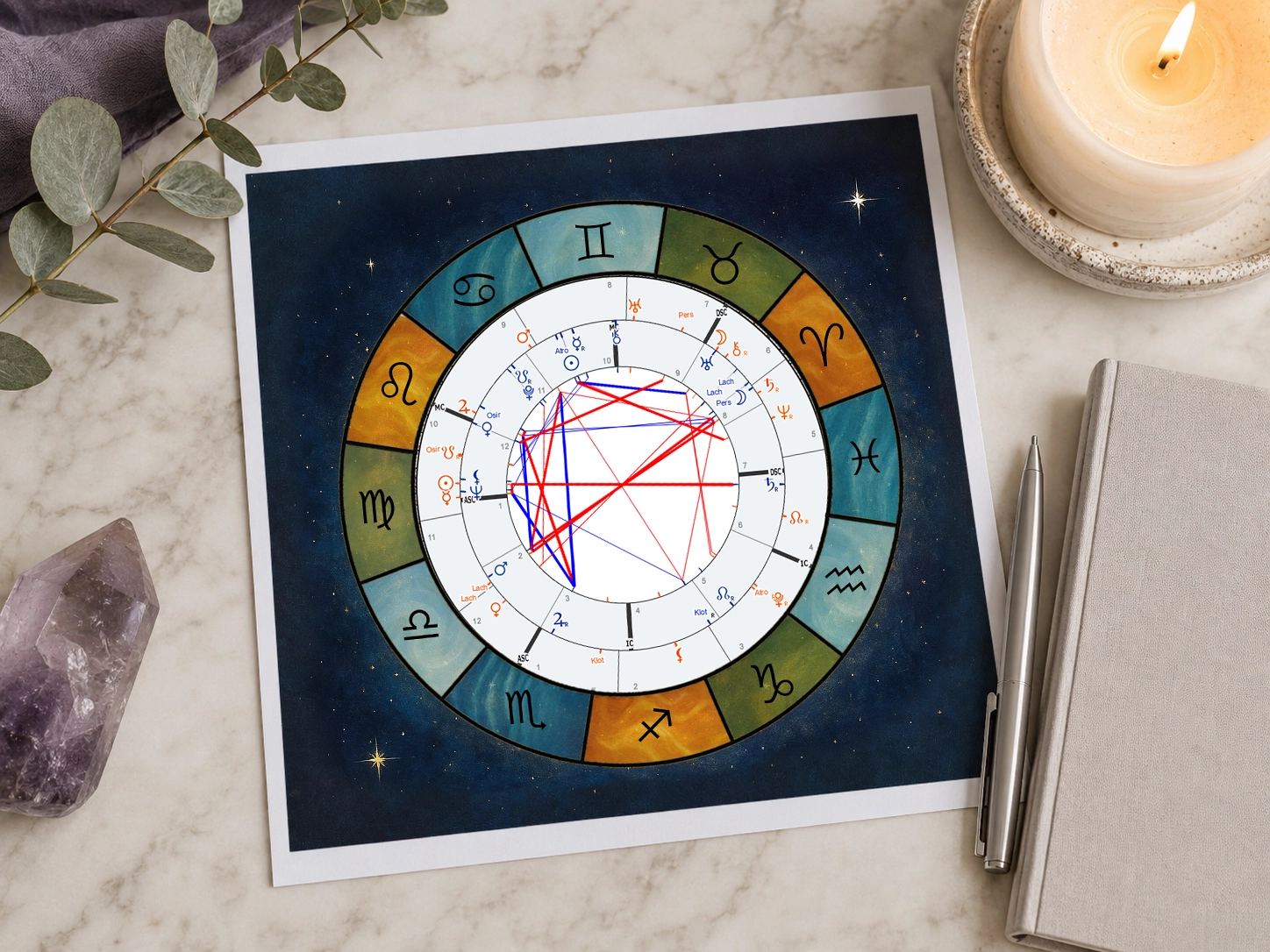
A transit describes the relationship between the planets moving through the sky now and the planetary positions in your birth chart.
I think of it as a conversation between the living sky and the map you were born with.
And like most conversations, the meaning isn’t found in one word alone.
What Are Transits in Astrology?
Your natal chart, your birth chart, is a map of the sky at the moment you were born.
The Sun, Moon, planets and other points occupied specific zodiac signs and degrees. They fell into particular houses and formed geometric relationships with one another called aspects.
That natal pattern stays with you.
But the sky doesn’t stop moving just because you arrived.
Mercury keeps orbiting. Saturn keeps making its long pilgrimage around the zodiac. Jupiter returns approximately every twelve years. Uranus, Neptune and Pluto move so slowly that their transits can shape entire chapters of our lives.
As those planets move, they form new relationships with the placements in your natal chart.
Those relationships are what astrologers call transits.
So when someone says, “Saturn is transiting my Moon,” they’re describing a current Saturn position forming a specific relationship to the Moon in their birth chart.
And this is where astrology becomes far more interesting than the daily horoscope version of:
“You’re a Capricorn, so today you may receive an email.”
Yes. Probably. Most of us will.
The natal chart gives us something much more specific to work with.
We Share the Sky. We Don’t Share the Same Chart.
This is one of the most important things to understand about current astrology transits.
We all live beneath the same planetary weather.
But that weather lands differently in each person’s chart.
Imagine a storm moving across a landscape.
One person lives beside a river.
Another lives on a hill.
Someone else has a garden that desperately needed rain.
Same storm.
Different terrain.
Astrology works similarly.
Jupiter entering a new sign is a collective event. Everyone is living inside that larger planetary shift.
But Jupiter may be moving through your seventh house of relationship while traveling through someone else’s tenth house of vocation.
For another person, Jupiter may be sitting directly on their natal Venus.
For someone else, it may not be forming a particularly strong personal aspect at all.
This is why I hesitate whenever astrology becomes too universal.
The sky may be collective.
The conversation is personal.
The Sky Is Not Speaking in Separate Sentences
Something this work keeps teaching me is that astrology gets distorted when we pull one transit out of the sky and treat it as if nothing else is happening.
The planets are not taking turns.
Saturn does not politely finish his lesson before Uranus enters the room.
Mercury does not wait for eclipse season to end because everyone already has enough going on.
The sky is not speaking in separate sentences.
These movements are responding to one another.
I sometimes describe the chart like a full meal because it makes more sense to me than a list of ingredients.
Saturn might provide the structure.
Mars brings heat.
Venus changes the texture.
Jupiter adds something generous or excessive—sometimes both.
Neptune can dissolve the edges.
Pluto is somewhere in the kitchen quietly reducing the sauce for eight hours and refusing to tell anyone exactly what he’s doing.
One planet can absolutely be important.
But the atmosphere comes from the composition.
This is why a meaningful transit reading looks beyond “What does Saturn mean?” and asks:
What is Saturn doing here, in this chart, at this moment, while everything else is also moving?
That is a much better question.
The Planet Tells Us What Kind of Energy Is Moving
Each planet carries an archetypal function.
Very simply:
The Sun illuminates identity, vitality and conscious direction.
The Moon speaks to emotional rhythms, instinct, belonging and what helps us feel safe.
Mercury describes thought, communication, perception, learning and exchange.
Venus relates to value, attraction, relationship, receptivity and what we find beautiful or worthwhile.
Mars activates desire, movement, assertion, conflict and the instinct to act.
Jupiter expands, explores, teaches and asks us to encounter a larger horizon.
Saturn gives form, limits, responsibility, maturation and consequence.
Uranus disrupts stale patterns and introduces liberation, invention and change.
Neptune softens boundaries and speaks through imagination, longing, spirituality, ideals and sometimes confusion.
Pluto takes us into power, shadow, compulsion, transformation and the things that cannot remain superficial forever.
None of those descriptions is automatically “good” or “bad.”
And that’s important.
Jupiter can expand something we would rather not expand.
Saturn can stabilize something we desperately needed to become real.
Uranus can free us and terrify us in the same afternoon.
Context matters.
The House Shows Us Where Life Is Being Activated
If the planet describes what kind of force is moving, the astrological house often tells us where we’re likely to encounter it.
The twelve houses describe different territories of lived experience.
Identity.
Resources.
Communication.
Home.
Creativity.
Work and wellbeing.
Partnership.
Shared resources and intimacy.
Belief and meaning.
Career and public life.
Community.
Inner life and surrender.
When a planet moves through one of these houses, that area of life tends to become part of the conversation.
I like to think of the houses as rooms in the natal chart.
The planet walks into the room.
Now we ask:
What is already happening in here?
What does this planet notice?
What gets stirred up?
What needs attention?
And perhaps most importantly:
What is asking to become conscious?
Aspects Tell Us How the Transit Meets the Natal Chart
Transiting planets also form aspects to natal planets and points.
These geometric relationships help describe the quality of the interaction.
A conjunction concentrates energy.
An opposition often brings polarity, relationship or reflection.
A square creates tension that can require movement.
A trine can create ease, flow or available support.
A sextile often presents an opening—but usually one we still have to participate in.
I don’t think challenging aspects exist to punish us.
Life does not need astrology’s help creating inconvenience.
Instead, difficult aspects often create enough pressure that we can no longer comfortably maintain an old arrangement.
A square can say:
This isn’t fitting anymore.
An opposition may ask:
Can you see what you couldn’t see from your side of the room?
A conjunction can intensify something until it becomes impossible to ignore.
Even harmonious aspects aren’t cosmic permission slips to lie on the couch waiting for destiny to ring the doorbell.
They describe available conditions.
We still participate.
Fast Transits and Slow Transits Feel Different
Not every transit deserves the same amount of attention.
The Moon can activate a natal placement for hours.
Mercury, Venus and Mars often describe shorter periods of activation—days or weeks, depending on their movement and retrograde cycles.
Jupiter and Saturn work more slowly.
The outer planets—Uranus, Neptune and Pluto—can remain in relationship with a natal placement for months or even years.
Those slower transits tend to describe larger developmental seasons rather than isolated events.
And I think this is where people sometimes misunderstand astrology.
A Pluto transit may coincide with an important external event.
But often its deeper story is about how your relationship with power, control, loss, truth or transformation changes across an entire period of life.
Saturn may coincide with a responsibility becoming unavoidable.
But the real transit may be about learning what you are willing to commit to – and what you no longer have the energy to carry simply because you always have.
The event is not always the whole story.
Sometimes the transit is the chapter.
Why Some Transits Seem to Repeat Themselves
I’ve been noticing this in my own life for years: astrology has a way of circling back around a theme until I can finally see the pattern underneath the circumstances.
Not because the universe is handing out detention slips.
More because life seems remarkably committed to repetition as a teaching method.
Retrogrades are an obvious example.
A planet may cross the same natal degree three times:
once while moving direct,
again while retrograde,
and a final time after stationing direct.
The external circumstances may change each time.
But the underlying question often develops.
The first pass introduces something.
The retrograde pass complicates, deepens or revisits it.
The final pass may reveal what has actually changed.
This is one reason I pay attention to patterns more than predictions.
Patterns tell us much more.
Astrology Is Most Useful When It Gives You More Agency, Not Less
This is the part I care about deeply.
Astrology can become surprisingly disempowering when every difficult mood is blamed on a planet and every decision is postponed until the sky offers perfect conditions.
I’ve done enough living to know that perfect conditions are not usually coming.
There will always be another transit.
Another retrograde.
Another square.
Another eclipse season.
Another Tuesday.
The point isn’t to organize our lives around avoiding celestial discomfort.
The point is to develop enough awareness that we have more choices inside the experiences we’re already having.
A Saturn transit can help us recognize where life is asking for structure.
A Uranus transit can illuminate where we’ve confused familiarity with freedom.
Neptune may reveal where longing has become projection.
Pluto may expose a dynamic we’ve spent years trying not to name.
Astrology doesn’t make those decisions for us.
It helps us see the terrain.
Awareness creates room for choice.
That is where astrology becomes useful.
How to Read a Transit in Your Own Birth Chart
You don’t need to interpret the entire sky every morning.
Please don’t.
There are already enough tabs open in everyone’s browser.
Start with one significant transit.
Ask four questions.
1. Which planet is moving?
What archetypal function does that planet describe?
Saturn and Venus do not arrive with the same agenda.
2. Which house is it moving through?
What territory of your life is receiving the activation?
3. Is it making a close aspect to a natal planet or angle?
This can show where the transit becomes particularly personal.
4. What is actually happening in your life?
This is the part no astrology software can live for you.
What themes have been repeating?
Where is there pressure?
Where is something opening?
What are you grieving, building, questioning, releasing or becoming?
Then bring the symbolism and lived experience together.
That meeting point is where interpretation begins.
A Simple Transit Reflection Practice
If you want to begin tracking your own astrology transits, choose one major transit and keep a small record of it.
Nothing elaborate.
You do not need seventeen crystals, a ceremonial robe and a fountain pen made during the Age of Aquarius.
Unless you want those things. I support ambiance.
Write down:
- the transit
- the house involved
- the natal planet or point being activated
- the dates of exact contact
- what you’re noticing in your actual life
- any themes that repeat
Then return to your notes later.
This matters because astrology becomes much more meaningful when we observe our own patterns instead of simply inheriting someone else’s interpretation of them.
Over time, you begin learning your personal relationship with the planets.
And that is far more useful than memorizing a list of transit keywords.
The Living Sky
Your birth chart isn’t a frozen verdict about who you are.
I think of it more like an instrument.
The structure is there.
The strings are there.
But different transits touch different notes.
Some seasons are quiet.
Some resonate through every room in the house.
Some feel dissonant before we understand what they’re teaching us to hear.
The living sky continues to meet the natal chart as we continue becoming the person living it.
That is the beauty of transit work.
We are not trying to predict every event.
We are learning to recognize timing.
To see patterns.
To understand why certain themes become louder in particular seasons.
And, ideally, to meet those seasons with a little more consciousness than we might have otherwise.
Sometimes the astrology confirms something we’ve known in our bones for months.
Sometimes it gives language to an experience we couldn’t quite name.
And sometimes it simply reminds us:
Ah. This is a season.
Not a life sentence.
Questions to Sit With
- What theme has been repeating loudly enough that I can no longer call it coincidence?
- Where in my life am I being invited to respond differently rather than simply react again?
- If this season is asking something of me, what might that actually be?
The sky can help us understand the map.
But we are still the ones walking the terrain.
And I think that’s exactly how it should be.
With roots and stardust,
Joeii Starr
The Charmed Compass
🧭 Help Keep the Compass Turning
If something I’ve shared helped you find clarity, peace, or a new perspective, you’re welcome to help support the continued creation of this work.
Every contribution helps sustain the research, writing, illustration, classes, and evolving projects behind The Charmed Compass.
Thank you for walking this path with me.

Joeii Starr is the founder of The Charmed Compass and a Consciousness Systems Architect whose work explores the meeting place of astrology, archetype, ritual, land, and lived experience. Through Transit Oracle, Field Notes, and her broader body of work, she documents the conversations unfolding between the sky above, the earth below, and the evolving human heart.




One Comment